Craps Odds Bet: Why It Has No House Edge and What 3-4-5x Odds Do
The odds bet behind the pass line pays true odds, so it carries no house edge at all. The dice arithmetic behind 3-4-5x odds and how far it pulls the combined edge down.
Gamble Verdict desk·· 7 min read
The odds bet in craps, placed behind a pass line bet once a point is set, pays exactly the true odds of the point being made, so it carries no house edge. The pass line itself carries an edge of 1.41 percent. Taking odds does not reduce the dollars a player is expected to lose, but it spreads that loss over more money wagered, which brings the combined edge down to 0.85 percent at 1x odds and 0.37 percent at a 3-4-5x table. Every figure below is derived from the 36 equally likely outcomes of two dice.

The dice arithmetic that sets every number
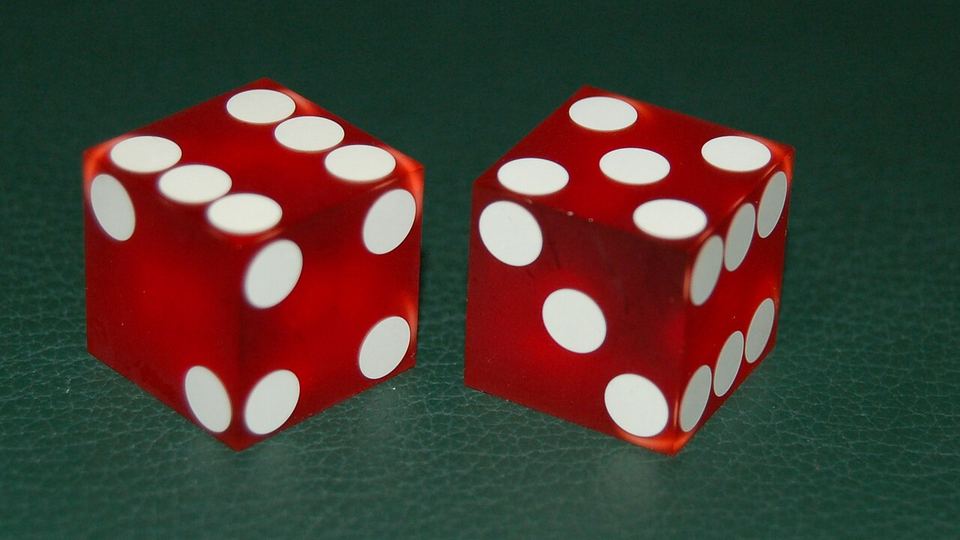
Two six-sided dice produce 6 × 6 = 36 equally likely combinations. The number of ways to roll each total is:
| Total | 2 | 3 | 4 | 5 | 6 | 7 | 8 | 9 | 10 | 11 | 12 |
|---|---|---|---|---|---|---|---|---|---|---|---|
| Ways | 1 | 2 | 3 | 4 | 5 | 6 | 5 | 4 | 3 | 2 | 1 |
Once a point is established, only two totals matter: the point and 7. Every other roll is ignored. So the chance of making the point before a 7 is the ways to roll the point divided by the ways to roll the point or a 7:
- Point 4 or 10: 3 ways against 6 ways for a 7. Probability of winning = 3 ÷ 9 = 1/3. True odds against = 6 to 3 = 2 to 1.
- Point 5 or 9: 4 ways against 6. Probability = 4 ÷ 10 = 2/5. True odds = 6 to 4 = 3 to 2.
- Point 6 or 8: 5 ways against 6. Probability = 5 ÷ 11. True odds = 6 to 5.
The casino pays the odds bet at exactly these ratios: 2 to 1 on 4 and 10, 3 to 2 on 5 and 9, 6 to 5 on 6 and 8. A fair payout times the probability of winning, minus the probability of losing, is zero. On a point of 6, for example, a $5 odds bet wins $6 with probability 5/11 and loses $5 with probability 6/11: (5/11 × 6) − (6/11 × 5) = 30/11 − 30/11 = 0. The same check comes out to zero on every point. That is why the odds bet has no house edge.
Where the pass line's 1.41 percent comes from
The pass line is where the house's edge sits. Its win probability is built from the come-out roll and the point phase.
Come-out roll. A 7 or 11 wins immediately: 6 + 2 = 8 ways out of 36. A 2, 3 or 12 loses: 1 + 2 + 1 = 4 ways. Any other total (4, 5, 6, 8, 9, 10) sets a point: 24 ways.
Point phase. The probability of winning by setting and then making each point is the chance of rolling that point on the come-out times the chance of repeating it before a 7:
- 4: (3/36) × (3/9) = 1/36
- 5: (4/36) × (4/10) = 2/45
- 6: (5/36) × (5/11) = 25/396
- 8, 9 and 10 mirror 6, 5 and 4.
Adding the come-out wins and both halves of the point wins:
8/36 + 2 × (1/36 + 2/45 + 25/396) = 244/495, or about 0.49293.
The probability of losing is 1 − 244/495 = 251/495. With an even-money payout, the expected value per $1 pass line bet is 244/495 − 251/495 = −7/495, which is a house edge of 1.414 percent, usually rounded to 1.41.
On a $10 pass line bet, the expected loss is $10 × 7/495 = about 14.1 cents per bet resolved.
What 3-4-5x odds means, and why it equalizes the win at six times the flat bet
A table posting "3-4-5x odds" lets a player take odds of up to 3 times the pass line bet on a point of 4 or 10, 4 times on 5 or 9, and 5 times on 6 or 8. The multiples look arbitrary until they are multiplied by the payouts:
| Point | Maximum odds | True-odds payout | Odds win (as a multiple of the flat bet) |
|---|---|---|---|
| 4 or 10 | 3x | 2 to 1 | 3 × 2 = 6 |
| 5 or 9 | 4x | 3 to 2 | 4 × 1.5 = 6 |
| 6 or 8 | 5x | 6 to 5 | 5 × 1.2 = 6 |
Whatever the point, a full odds bet wins exactly six times the flat bet. Add the even-money flat win and the total payoff when the point is made is seven times the pass line bet on every point. With a $10 pass line bet and full odds, the player has $40 in action on a 4 ($10 + $30) and wins $70 ($10 + $60); has $50 on a 5 and wins $70; has $60 on a 6 and wins $70. The structure keeps payouts uniform for the dealers while letting the odds bet scale to each point's true odds.
Note that 6 and 8 allow the largest odds bet (5x) and pay the least per dollar (6 to 5), because those points are the most likely to be made.
The combined house edge at 1x, 2x and 3-4-5x odds
Since the odds bet has an expected value of zero, adding it never changes the dollar amount a player is expected to lose. The pass line's −7/495 per $1 flat bet is still the only negative term. What changes is the denominator: the total amount wagered per pass line decision.
The combined edge is therefore:
Combined edge = (7/495) ÷ (1 + average odds bet per pass line bet)
The average odds bet is not simply the multiple, because odds are only placed when a point is set, which happens on 24 of the 36 come-out outcomes, or 2/3 of the time.
- 1x odds: average odds bet = (2/3) × 1 = 0.667. Combined edge = 1.414% ÷ 1.667 = 0.848%.
- 2x odds: average odds bet = (2/3) × 2 = 1.333. Combined edge = 1.414% ÷ 2.333 = 0.606%.
- 3-4-5x odds: the multiple depends on the point, so weight each by its come-out probability: (6/36 × 3) + (8/36 × 4) + (10/36 × 5) = (18 + 32 + 50) ÷ 36 = 100/36 = 2.778. Combined edge = 1.414% ÷ 3.778 = 0.374%.
The same formula applies to any multiple:
| Odds allowed | Average total bet per $1 flat | Combined house edge |
|---|---|---|
| None | 1.000 | 1.414% |
| 1x | 1.667 | 0.848% |
| 2x | 2.333 | 0.606% |
| 3x | 3.000 | 0.471% |
| 3-4-5x | 3.778 | 0.374% |
| 5x | 4.333 | 0.326% |
| 10x | 7.667 | 0.184% |
| 100x | 67.667 | 0.021% |
The edge falls toward zero as the odds multiple grows, but it never reaches zero, because the pass line bet always has to be made first.
Don't pass with lay odds, and what odds do and do not change
The don't pass bet is the mirror image, with one adjustment: on the come-out roll a 12 is a push rather than a win for the don't bettor (the "bar 12" rule). Working through the same arithmetic:
- Win: 2 or 3 on the come-out (3 ways out of 36), plus a 7 before the point, which has probability 6/9, 6/10 or 6/11. Total = 949/1980.
- Lose: exactly the pass line's win probability, 244/495 = 976/1980.
- Push: a 12 on the come-out, 1/36 = 55/1980.
Expected value per $1 = (949 − 976) ÷ 1980 = −27/1980 = −3/220, a house edge of 1.364 percent per bet made.
The don't side takes odds by laying them: the player risks more than they win, at the true odds. On 4 or 10 the player lays 2 to win 1, on 5 or 9 lays 3 to win 2, on 6 or 8 lays 6 to win 5. At a 3-4-5x table, the lay limit works out to six times the flat bet on every point, because laying 6 units wins 3 on a 4, 4 on a 5 and 5 on a 6, the same win limits the pass line player has.
With lay odds equal to a fixed multiple k of the flat bet on every point, the combined edge is (3/220) ÷ (1 + (2/3) × k):
- k = 1: 1.364% ÷ 1.667 = 0.818%
- k = 2: 1.364% ÷ 2.333 = 0.584%
- k = 6 (the 3-4-5x lay limit): 1.364% ÷ 5 = 0.273%
Some tables define don't-side odds limits by the amount won rather than the amount laid, which changes the average lay and therefore the combined figure. The rule card states which convention applies.
What adding odds changes, and what it does not:
- It does not change expected dollar loss. A $10 pass line bet loses about 14.1 cents per decision on average whether the player takes no odds or full 3-4-5x odds.
- It lowers the edge per dollar wagered, as shown in the tables above. A player who would otherwise bet $40 flat on the pass line can bet $10 flat with $30 odds instead and face a lower combined edge for similar money in action.
- It raises variance. A player with $10 on the pass line and $50 in odds on a 6 can lose $60 on a single seven-out. Over short sessions, larger swings are the main practical effect of taking odds.
- It does not change the pass line's 1.41 percent. The odds bet sits on top of the line bet and cannot be made without it.
General information on how games, odds and gambling rules work. It is not advice to place any bet, and rules, prices and limits change; check the operator’s or regulator’s own page before acting.