9/6 Jacks or Better Meaning: How Two Numbers Set the Return
The 9 and the 6 are the full house and flush payouts, and those two numbers set most of a Jacks or Better machine's return. How to read the table and rank machines fast.
Gamble Verdict desk·· 6 min read
"9/6" names a Jacks or Better video poker pay table that pays 9 coins per coin bet for a full house and 6 per coin for a flush. With the rest of the standard table in place and every hand played correctly, that version returns 99.5439% of the money wagered, according to the hand-by-hand tables published by Wizard of Odds. Each step down on either number costs roughly one percentage point, and a machine's pay table, printed on the glass, is enough to tell which version is on offer.
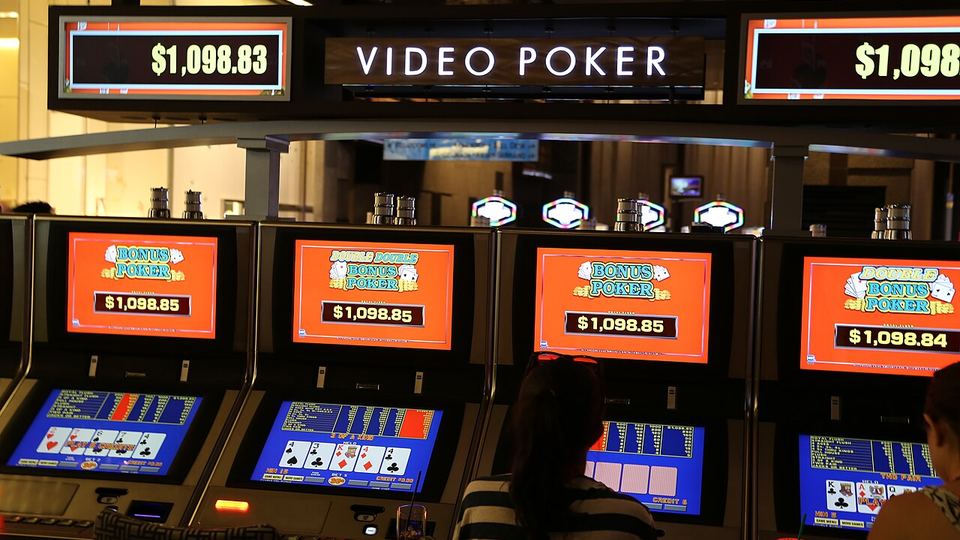

What the 9 and the 6 stand for
Jacks or Better is draw poker against a fixed pay schedule. The player is dealt five cards, holds any of them, draws replacements, and is paid according to the final hand. A pair of jacks or better returns the bet, two pair pays 2 for 1, three of a kind pays 3, a straight pays 4, and from there the table climbs to the royal flush.
Most of that ladder is the same from one machine to the next. The two rungs operators adjust are the full house and the flush. Shorthand names therefore list only those two payouts: 9/6 (full house 9, flush 6), 9/5, 8/6, 8/5, 7/5 and 6/5. A player who sees "9/6" on a sign or a strategy chart is being told the version of the game, not a denomination or a bet size.
The full 9/6 table, with the probability of each final hand under optimal play and the share of the total return each hand produces, comes from Wizard of Odds:
| Final hand | Pays per coin | Probability | Contribution to return |
|---|---|---|---|
| Royal flush | 800 | 0.00002476 | 0.01980661 |
| Straight flush | 50 | 0.00010931 | 0.00546545 |
| Four of a kind | 25 | 0.00236255 | 0.05906364 |
| Full house | 9 | 0.01151221 | 0.10360987 |
| Flush | 6 | 0.01101451 | 0.06608707 |
| Straight | 4 | 0.01122937 | 0.04491747 |
| Three of a kind | 3 | 0.07444870 | 0.22334610 |
| Two pair | 2 | 0.12927890 | 0.25855780 |
| Jacks or better | 1 | 0.21458503 | 0.21458503 |
| Nothing | 0 | 0.54543467 | 0 |
Two things stand out in that table. First, the large payouts matter less than they look. The royal flush, at 800 per coin, contributes just under 2 points of the total, while three of a kind, paying only 3 for 1, contributes more than 22 points. Second, most hands lose: the "nothing" row is 54.5%, so by subtraction about 45.5% of hands return at least the original bet, and a little under half of those (21.5% of all hands) only return it.
The same source lists the royal flush at 493,512,264 combinations out of 19,933,230,517,200 possible outcomes under optimal strategy. Dividing one by the other gives about one royal every 40,391 hands.
Pay tables and the returns they produce
Because the full house and flush are the only rows that change, the gap between versions can be measured directly. Wizard of Odds publishes the return for each common variant, all assuming optimal strategy for that specific table:
| Pay table (full house / flush) | Return | House edge (100% minus return) |
|---|---|---|
| 9/6 | 99.5439% | 0.4561% |
| 9/5 | 98.4498% | 1.5502% |
| 8/6 | 98.3927% | 1.6073% |
| 8/5 | 97.2984% | 2.7016% |
| 7/5 | 96.1472% | 3.8528% |
| 6/5 | 94.9961% | 5.0039% |
The arithmetic behind those steps is visible in the first table. Lowering the full house from 9 to 8 removes one coin per coin bet on a hand that occurs with probability 0.01151221, which is about 1.15 points of return. The published gap between 9/6 and 8/6 is 99.5439 minus 98.3927, or 1.1512 points: the same figure.
Lowering the flush from 6 to 5 would remove 0.01101451, or about 1.10 points, if nothing else changed. The published gap between 9/6 and 9/5 is 1.0941 points, slightly smaller. The difference exists because the optimal strategy itself shifts when flushes pay less: a few borderline holds that chase a flush on 9/6 become worse choices on 9/5, and correct play recovers a sliver of the loss.
The house edge column shows why the shorthand matters. On 8/5, the expected loss is 2.7016% of money wagered; on 9/6 it is 0.4561%. Dividing one by the other gives a ratio of about 5.9. Over $10,000 of total wagers, the expected cost works out to about $45.61 on 9/6 and about $270.16 on 8/5, by multiplying each edge by the amount wagered. On 6/5 the same $10,000 carries an expected cost of about $500.39. These are long-run averages. Any single session can land far above or below them, largely because the royal flush is both rare and a meaningful slice of the return.
Why the deck makes the math public
For most slot machines, a player has no way to calculate the return from what is shown on the screen, because reel weightings and symbol frequencies are not displayed. Video poker is different, and Nevada's rules are a large part of the reason.
Nevada Gaming Commission Regulation 14 sets technical standards for gaming devices. The text of Regulation 14.040, as published by the Nevada Gaming Control Board in its 2016 amendment materials (Regulation 14 draft, Nevada Gaming Control Board), includes several provisions that bear directly on video poker:
- Section 14.040(1)(a) requires a theoretical payout of "not less than 75 percent for each wager."
- Section 14.040(5) states: "For gaming devices that are representative of live gambling games, the mathematical probability of a symbol or other element appearing in a game outcome must be equal to the mathematical probability of that symbol or element occurring in the live gambling game."
- Section 14.040(2) bars changing the rules, probability or award once a game has been initiated.
- Section 14.040(7) bars devices from altering any function based on their actual hold percentage.
Section 14.040(5) is the provision that turns the pay table into a complete description of the game. If a video poker machine represents a 52-card deck, each card must appear with the probability it would have in a real deck. Once the deck is fair and the payouts are printed, the return under perfect play is a fixed mathematical quantity that anyone can compute, which is exactly what the Wizard of Odds tables do. Section 14.040(7) closes the obvious loophole: a machine cannot tighten up after a run of player wins.
Other states set their own device standards, and the 75% floor in Nevada is far below any common Jacks or Better pay table. The practical point is narrower: in a jurisdiction that requires deck-faithful card probabilities, the posted pay table plus the player's own decisions determine the return. Nothing hidden inside the machine changes it.
Reading a machine before playing
Three checks cover most of what the pay table reveals.
Find the full house and flush rows. On the glass or the help screen, read the per-coin payouts for the full house and the flush. Machines frequently show the 5-coin column (45 and 30 on 9/6, for example); dividing by five recovers the per-coin figures. The pair "9/6" in that position is the full-pay version described above.
Check the royal flush at maximum coins. Pay tables commonly list the royal at 250 per coin for one to four coins and 4,000 coins for five coins, which is 800 per coin. The 800 figure is what the returns in the tables above assume. A rough sense of what playing short coins costs comes from the probability column: 0.00002476 multiplied by the 550-per-coin difference between 800 and 250 is about 0.0136, or roughly 1.36 points of return, before any adjustment to strategy. That estimate is arithmetic on the published probability, not a separately published figure, but subtracting 1.36 from 99.54 leaves about 98.18%, below the published returns for 9/5 and 8/6 played at full coin.
Confirm the rest of the ladder. The returns above depend on the standard schedule of 1, 2, 3, 4, 25, 50 and 800 for the other hands. A machine that pays jacks or better but labels itself differently, or changes the two pair or four of a kind payout, is a different game and the 9/6 figure no longer applies.
The return figures also assume optimal strategy. That means following a hold chart computed for the exact pay table in front of the player, since the right hold for some hands changes between 9/6 and 9/5. Deviating from correct play lowers the return; the size of the drop depends on how often and how badly the errors occur, and is not a fixed number.
The final caveat is the one built into the first table. A 99.54% return is an average over an enormous number of hands, with a royal arriving about once in every 40,391. Over a few thousand hands, results are dominated by whether that one hand shows up. The pay table sets the long-run price of the game. It does not shorten the run.
General information on how games, odds and gambling rules work. It is not advice to place any bet, and rules, prices and limits change; check the operator’s or regulator’s own page before acting.