Running It Twice in Poker: Why It Cuts Variance but Not Expected Value
Dealing the board twice splits an all-in pot into two chances without changing what either player expects to win. The proof, a worked example and the card-removal question.
Gamble Verdict desk·· 6 min read
Running it twice does not change a player's expected value. When an all-in pot is split into two half-pots and the remaining board is dealt twice from the same deck, each player's chance of winning each half is exactly their all-in equity, so the expected share of the pot is the same as with one runout. What changes is the spread of results: the chance of losing the whole pot falls, the chance of winning the whole pot falls, and a split becomes the most common outcome.
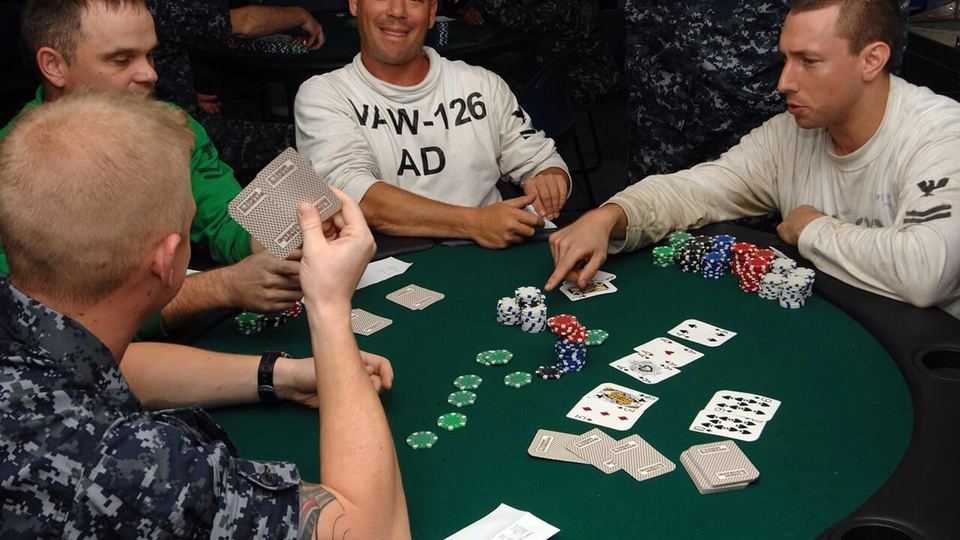
_and_Carrier_Air_Wing_(CVW)_3_compete_in_a_Texas_Hold_%27Em_Poker_tournament_aboard_Harry_S._Truman.jpg)
How running it twice works at the table
The situation is always the same. Two players are all in before the board is complete, no more betting can happen, and the only thing left is to deal the remaining community cards. Instead of dealing them once for the whole pot, the players agree to deal them twice, each time for half the pot.
The mechanics:
- The players' hole cards and any board cards already dealt stay as they are.
- The dealer completes the board once from the deck. The winner of that board takes half the pot.
- Without returning those cards to the deck or reshuffling, the dealer completes a second board from the cards that remain. The winner of that board takes the other half.
- If one player wins both boards, that player takes the whole pot. If each wins one, they split it. A board that is a tie is split as usual within its half.
Whether this is allowed at all is a house rule. Cardrooms that permit it in cash games set the conditions in their posted rules, and it generally requires both players in the hand to agree. Tournament rules are written separately from cash-game rules, so permission in one does not imply permission in the other. A player who is unsure should ask the floor before agreeing, because the question is always about the house's rule, not about the arithmetic.
The arithmetic is the same everywhere, and it is the reason the offer is usually framed as costless: it is.
A worked example: overpair against a nine-out flush draw
Take a standard spot. On the flop, one player holds an overpair and the other holds a flush draw. Both are all in, and the pot is $1,000, with each having put in $500.
To keep the counting clean, assume the flush draw wins only by completing the flush, and the overpair wins every other runout. That gives the draw 9 outs. Real hands have small extra pieces of equity in both directions, but the nine-out version shows the mechanics without changing the conclusion.
Unseen cards. 52 cards minus 4 hole cards minus 3 flop cards leaves 45.
One runout, turn and river. The overpair survives only if neither the turn nor the river is one of the 9 outs:
- P(miss turn) = 36 / 45
- P(miss river, given missed turn) = 35 / 44
- P(overpair wins) = (36 / 45) × (35 / 44) = 1,260 / 1,980 = 63.64%
- P(flush draw wins) = 1 − 0.6364 = 36.36%
With one runout, the overpair's expected value from the $1,000 pot is 0.6364 × $1,000 = $636.36, and the flush draw's is $363.64.
Two runouts. Now deal two turn-and-river pairs, four cards in total, from the same 45 unseen cards.
- Overpair wins both boards. All four cards must be non-outs. There are C(36, 4) ways to draw four non-outs out of C(45, 4) four-card sets, which is 58,905 / 148,995 = 39.53%.
- Flush draw wins both boards. By inclusion-exclusion: 1 − P(draw misses board one) − P(draw misses board two) + P(draw misses both). Each board alone is missed with probability C(36, 2) / C(45, 2) = 630 / 990 = 63.64%, and both are missed 39.53% of the time, so this is 1 − 0.6364 − 0.6364 + 0.3953 = 12.26%.
- Split. Everything else: 1 − 0.3953 − 0.1226 = 48.20%.
| Outcome for the overpair | Run once | Run twice |
|---|---|---|
| Wins the whole $1,000 | 63.64% | 39.53% |
| Wins $500 (split) | not possible | 48.20% |
| Wins nothing | 36.36% | 12.26% |
| Expected value | $636.36 | $636.36 |
The expected value with two runouts is ($1,000 × 0.3953) + ($500 × 0.4820) + ($0 × 0.1226) = $395.35 + $241.01 + $0 = $636.36. The same number, to the cent.
The spread is what moves. With one runout, the overpair either takes $1,000 or nothing; the standard deviation of that result is $1,000 × √(0.6364 × 0.3636) = $481.05. With two runouts, the standard deviation falls to $333.01. The chance of walking away with nothing drops from 36.36 percent to 12.26 percent. In exchange, the chance of scooping drops from 63.64 percent to 39.53 percent.
A turn all-in, for comparison. If the money goes in on the turn instead, there are 44 unseen cards and one card to come. The draw wins one runout with probability 9 / 44 = 20.45 percent. Run twice, the draw scoops only if both rivers are outs: (9 / 44) × (8 / 43) = 72 / 1,892 = 3.81 percent. The made hand scoops with (35 / 44) × (34 / 43) = 1,190 / 1,892 = 62.90 percent, and the rest, 33.30 percent, is a split. The made hand's chance of losing the whole pot falls from 20.45 percent to 3.81 percent, with expected value unchanged.
Why expected value cannot move, including the card-removal objection
The proof in one line. The payoff from running it twice is half the pot times the result of board one plus half the pot times the result of board two. Expected value is linear, so the expected payoff is half the pot times P(win board one) plus half the pot times P(win board two). If each of those probabilities equals the player's all-in equity, the total is the pot times that equity, which is exactly the single-runout expected value. Nothing about dependence between the two boards enters this calculation, because linearity of expectation holds whether or not the two results are independent.
Why each board has the same probability. Board one is dealt from a well-shuffled deck, so its probability is the ordinary equity: 63.64 percent for the overpair above. Board two is dealt from the cards left after board one, which looks different, but before anything is dealt every four-card sequence from the stub is equally likely. The two cards that form board two are just as random a pair from the 45 unseen cards as the two that form board one. Taken on its own, without looking at what board one showed, board two's chance of missing the flush is the same 630 / 990 = 63.64 percent. The order in which a shuffled deck is dealt does not favor any position.
What card removal does change. Once board one is visible, board two's chances do shift. If board one contained a flush card, there are fewer outs left for board two; if board one bricked, the outs are all still in the stub and there are fewer blanks. In the flop example, the draw's chance of winning board two after it has already won board one is 12.26 / 36.36 = 33.72 percent, below its 36.36 percent starting equity. That is why the scoop figures in the table (39.53 and 12.26 percent) are a little lower than the 40.50 and 13.22 percent that two independent runouts would give, and the split figure is correspondingly higher.
Card removal therefore makes the two boards negatively correlated, which pushes even more results toward a split and reduces variance a little further than independent runouts would. It does not move expected value, because the average over all possible first boards of the second board's chances is still the original equity. The good first boards for the draw and the bad first boards for the draw balance out exactly.
What this means at the table. Agreeing or declining to run it twice is a choice about variance, not about money in the long run. A player who wants smaller swings on the bankroll has a reason to say yes. A player who prefers not to slow the game, or who simply does not care about the swing on one pot, loses nothing in expectation by saying no. The only thing that can change a player's expected value in an all-in spot is the decision that put the chips in, and that decision was made before anyone asked about the runout.
General information on how games, odds and gambling rules work. It is not advice to place any bet, and rules, prices and limits change; check the operator’s or regulator’s own page before acting.