Double After Split and Resplitting Aces: What Each Blackjack Rule Is Worth
DAS, RSA and doubling restrictions each move the blackjack house edge by a measurable amount. A rule-by-rule price list and the basic strategy splits that change with them.
Gamble Verdict desk·· 7 min read
In a six-deck shoe game, double after split (DAS) is worth about 0.14 percentage points to the player, resplitting aces (RSA) about 0.07 points, and hitting split aces about 0.19 points, according to the house edge calculator published by Wizard of Odds. Restricting doubles to 10 and 11 costs about 0.19 points. Each figure is small on its own, but taken together they can make one table cost noticeably more than the one next to it.
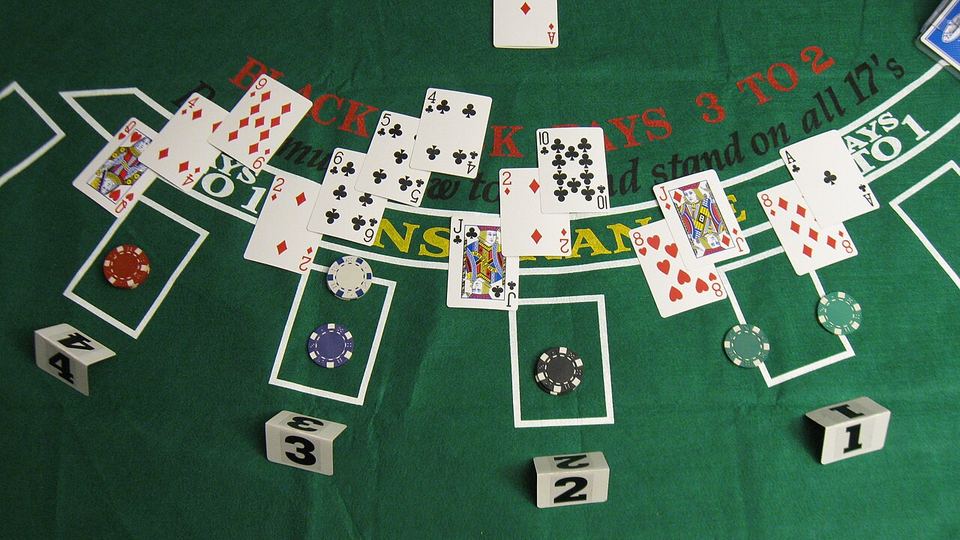

Reading the rule card before pricing anything
A blackjack rule card, or the felt itself, lists the game's terms in a shorthand that rarely explains itself. The abbreviations that matter for this article are:
- DAS (double after split). After splitting a pair, the player may double down on either resulting hand. Without DAS, a split hand can only be hit or stood.
- RSA (resplit aces). If a split ace receives another ace, the player may split again. Many games allow resplitting other pairs but not aces.
- Hit split aces. Most shoe games deal one card to each split ace and stop. A minority let the player keep drawing.
- D10 / D9 / DOA. Doubling allowed on 10 and 11 only, on 9 through 11 only, or on any first two cards.
- S17 / H17. Whether the dealer stands or hits on soft 17. This rule usually moves the edge more than any split rule does.
- Split to 2, 3 or 4 hands. The maximum number of hands a player can create by splitting and resplitting.
A card that reads "6D, H17, DAS, RSA, D10" therefore describes a six-deck game in which the dealer hits soft 17, doubling after a split is allowed, aces can be resplit, and first-two-card doubles are limited to 10 and 11. Each of those terms has a price, and the prices can be added up roughly to compare two tables.
One caution applies. Rule effects are not perfectly additive, because each rule changes how often other situations arise. Combined edges in the table below come straight from the calculator for each full rule set rather than from adding single-rule effects, so the totals already include those interactions.
What DAS, RSA and doubling limits do to the house edge
The Wizard of Odds blackjack house edge calculator lets a user set the deck count, the soft-17 rule, DAS, doubling limits, the resplit limit, RSA, hitting split aces, surrender and the blackjack payout, and returns the house edge under basic strategy. The figures below use the calculator's "basic strategy with cut card" output for six decks. The starting game is: dealer stands on soft 17, DAS allowed, double on any first two cards, split to four hands, no resplitting aces, no hitting split aces, no surrender, blackjack pays 3 to 2, and the player loses only the original bet to a dealer blackjack. That game carries a house edge of 0.43 percent. Each row then changes one rule.
| Rule change (six decks, S17 starting game) | House edge | Change vs. starting game |
|---|---|---|
| Starting game (DAS, double any two, split to 4, no RSA) | 0.43% | — |
| No double after split | 0.57% | +0.14 points |
| Resplit aces allowed | 0.36% | −0.07 points |
| Hit split aces allowed | 0.24% | −0.19 points |
| Resplit and hit split aces both allowed | 0.18% | −0.25 points |
| Double on 9–11 only | 0.52% | +0.10 points |
| Double on 10–11 only | 0.62% | +0.19 points |
| Split to 2 hands only | 0.48% | +0.05 points |
| Late surrender added | 0.35% | −0.07 points |
| Dealer hits soft 17 | 0.64% | +0.21 points |
The same calculator, with the dealer hitting soft 17, gives almost identical rule prices: removing DAS adds 0.15 points, allowing RSA subtracts 0.07, and limiting doubles to 10 and 11 adds 0.20.
The Wizard of Odds rule variations page, which measures each rule against an eight-deck game with S17, doubling on any two cards, DAS and splits to four hands, lands in the same range. It lists "player may not double after splitting" at −0.14 percent of player return, "player may resplit aces" at +0.08 percent, "player may draw to split aces" at +0.19 percent, "player may double on 10,11 only" at −0.18 percent and "player may double on 9-11 only" at −0.09 percent. The two sources agree within a few hundredths of a point, which is what one would expect when only the deck count differs.
Three practical readings follow from the table:
- DAS and a doubling restriction cost about the same. Losing DAS (+0.14) and moving from double-any-two to 10–11 only (+0.19) are both in the same band as the soft-17 rule (+0.21). A card showing "no DAS, D10" adds roughly a third of a percentage point to the house edge.
- RSA is the smallest of the split rules. A pair of aces is uncommon, and a second ace on a split ace is rarer still, so the right to resplit them is worth less than a tenth of a point.
- Hitting split aces is the largest player-friendly split rule, but it is also the rarest on US shoe tables. Its value comes from no longer being stuck with one card on hands such as A-2 or A-5.
Which basic strategy splits change when DAS is allowed
DAS does more than shave the house edge. It changes which pairs are worth splitting, because a split hand that may later be doubled is worth more. The Wizard of Odds text version of its four-to-eight-deck basic strategy (dealer stands on soft 17) gives the split rules as follows:
- Always split aces and 8s; never split 5s and 10s.
- Split 2s and 3s against a dealer 4 through 7, and against a 2 or 3 if DAS is allowed.
- Split 4s only if DAS is allowed and the dealer shows a 5 or 6.
- Split 6s against a dealer 3 through 6, and against a 2 if DAS is allowed.
- Split 7s against a dealer 2 through 7.
- Split 9s against a dealer 2 through 6 or 8 through 9.
The logic is visible in the pair of 4s. Without DAS, splitting 4-4 against a 5 turns one decent hand (a hard 8) into two weak starting hands of 4. With DAS, each of those hands that draws a 5, 6 or 7 becomes a 9, 10 or 11 that can be doubled against a weak dealer card. The extra doubles are what make the split pay.
The same reasoning extends the 2s, 3s and 6s splits down to the dealer's 2 and 3. Against those upcards the dealer busts less often than against a 5 or 6, so the split only becomes worthwhile when the player can press the advantage on the hands that improve.
A player who learned basic strategy at a DAS table and moves to a no-DAS table should stop splitting 4s altogether, and should stand pat (or hit, as the hard-total chart says) on 2-2, 3-3 and 6-6 against a dealer 2 or 3. Splitting on DAS terms at a no-DAS table gives up some of the small edge the DAS strategy was built to capture.
RSA and hitting split aces do not change any of the pair-splitting decisions above: aces are always split either way. What they change is what happens after the split, and the calculator prices that directly.
Pricing two tables side by side: a worked comparison
Suppose a player is choosing between two six-deck tables with the same limits.
- Table A: S17, DAS, double any two cards, split to four hands, no RSA, no surrender.
- Table B: S17, no DAS, double on 10–11 only, split to four hands, RSA allowed, no surrender.
Table B's card advertises RSA, which sounds like a concession. The procedure for pricing the two:
- Start from a known base. Table A matches the calculator's starting game exactly: 0.43 percent.
- Add each rule change for Table B. No DAS adds about 0.14 points, the 10–11 doubling limit adds about 0.19, and RSA subtracts about 0.07. The rough sum is 0.43 + 0.14 + 0.19 − 0.07 = 0.69 percent.
- Check the estimate against the full rule set. Entering all of Table B's rules into the calculator at once gives 0.67 percent. Simple addition came within two hundredths of a point because the interactions between these particular rules are small.
- Convert to money. At $25 a hand and an assumed 80 hands per hour, a player puts $2,000 in action each hour. Expected loss is $2,000 × 0.0043 = $8.60 per hour on Table A and $2,000 × 0.0067 = $13.40 per hour on Table B.
- Adjust the strategy for the table actually chosen. At Table B, drop the DAS-only splits listed in the previous section.
The difference is $4.80 an hour at those stakes, about 56 percent more expected loss at Table B, even though Table B's rule card includes the one rule (RSA) that most players would notice. The two rules it took away (DAS and doubling on any two cards) are worth nearly five times what RSA gives back.
A similar comparison often matters more than the split rules themselves. If Table A dealt with the dealer hitting soft 17, its edge would rise to 0.64 percent, close to Table B's 0.67. When several rules differ at once, the soft-17 rule and the doubling limits usually decide the comparison, and DAS and RSA adjust it at the margin.
All of these figures assume the player uses correct basic strategy for the exact rule set. A player who deviates, or who keeps splitting 4s at a no-DAS table, plays at a higher edge than any figure on this page.
General information on how games, odds and gambling rules work. It is not advice to place any bet, and rules, prices and limits change; check the operator’s or regulator’s own page before acting.